Elizabeth Lawrence Gilman (1905-2006) was the daughter of Arthur Lawrence Gilman (1878-1939) and Elizabeth Wright Walter (1875-1964). She was teh third cousin twice removed of my wife. Betty was born in 1905, graduated from Smith College in 1927, and married Malcolm Evelyn Anderson (1900-1950), a writer for the New Yorker, in 1936. They divorced in 1940. She was active in many organizations including: National Audubon Society, the Adirondack Mountain Club, the Society for the Preservation of the Adirondacks, the Saranac Lake Free Library, the Saranac Lake Village Improvement Society, and was a member of the Bohemians (a New York musicians’ club). She worked in New York in publishing and at FAO Schwartz. She died at the age of 101 in Kennett Square, Pennsylvania.
James H. Rutter
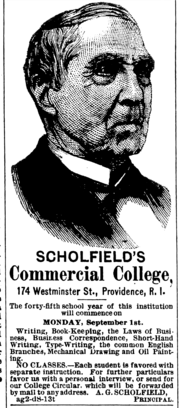
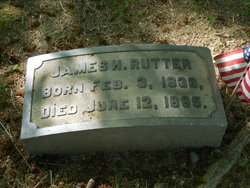
James H. Rutter (1836-1885) was my wife’s great great grandfather. He was born February 3, 1836 in Lowell, Massachusetts. He studied at the Scholfield business school
At the age of 18, in 1854, he started his career as a clerk in the freight office of the Erie Railroad. The next year he became chief clerk in the freight office of the Williamsport and Elmira Railroad. In 1857, at the age of twenty-one, he became chief clerk in the Chicago freight office of the Michigan Central and Northern Indian Railroad. In 1858 he became freight agent of the Chicago and Milwaukee Railroad. In 1860 he was back in Elmira as the stationmaster of the Erie Railroad. In 1864 he became freight agent in Buffalo of the Erie Railroad, and in 1866 the assistant general freight agent.
While testifying about railroad rates, he impressed William H. Vanderbilt, who hired him in 1870 as the General Freight Agent of the New York Central with the salary of $15,000 a year ($250,000 in 2015 dollars). In 1877 he became a director of the New York Central, in 1880 Third Vice-President, and in 1883, at the age of forty-seven, President of the New York Central.
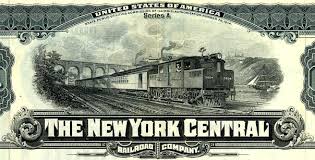
William Vanderbilt had been in poor health, (high blood pressure, mild stroke); he had sons, but knew that Rutter was more intelligent and competent than his heirs. Vanderbilt put Rutter in charge of 100,000 employees and $200,000,000 in capital (about $6 billion in 2023).
Mark Twain was scheduled to meet Rutter in 1885 to interest him in investing in the printing telegraph and the typesetter that Twain hoped would make his fortune, but Rutter was ill with diabetes at his house in Irvington and died on June 27, 1885.
At the same time, unbeknownst to each other, his wife Sarah Pollack Rutter was dying of brain inflammation. She died the next day, June 28, 1885.
They were buried from St. Thomas Church in New York at the same service. They left several children. They named one Nathaniel, after his uncle who had died at Chancellorsville, and ever afterwards there have been Nathaniels in the family. Their son, Nathaniel Enzie Rutter, was my wife’s great grandfather.
Thomas Agustus Jaggar
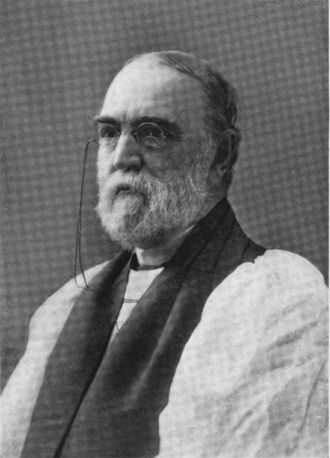
Thomas Augustus Jaggar (June 2, 1839 – December 13, 1912) was an American prelate who was bishop of the Episcopal Diocese of Southern Ohio from 1875 to 1904.
On April 22, 1862, he married Ann Louise Lawrence (1834-1908), my wife’s second cousin four times removed. She was the daughter of John W. Lawrence and Mary King Bowne, daughter of Walter Bowne. Their son, Thomas Augustus Jaggar, Jr., became a volcanologist.
Jaggar was born on June 2, 1839, in New York City, the son of Walter Jaggar and Julia Ann Niles. He was educated in New York City by private tuition, before commencing preparation for the ministry while engaging in business. He studied at the General Theological Seminary and graduated in 1860. In 1874, he was awarded a Doctor of Divinity from the University of Pennsylvania.[1]
Jagger was ordained deacon on November 10, 1860, and became assistant at St George’s Church in Flushing, Queens. In May 1862, he was appointed to, and given charge of, Trinity Church in Bergen Point. He was ordained priest on June 3, 1863, by the Bishop of New York Horatio Potter. In 1864, he became rector of Anthon Memorial Church in New York City (present-day All Souls Church), while in 1868, he succeeded as rector of St John’s Church in Yonkers, New York. Between 1870 and 1875, he served as rector of the Church of the Holy Trinity, Philadelphia.[2]
He was consecrated bishop on April 28, 1875, by Presiding Bishop Benjamin B. Smith. Following the election of Boyd Vincent as coadjutor in 1889, he was given oversight of American churches in Europe. He resigned in October 1904, and was named the tenth rector of The Cathedral Church of St. Paul, Boston, Massachusetts in 1906. He was bishop of tehAerican Protestant Episcopal Church in Europe from 1908 until He died in Cannes, France in 1912.
John Watson Lawrence, Lost at Sea
John Watson Lawrence (1869-1895) was the son of Walter Bowne Lawrence (1839-1912) and Annie Townsend (1841-1902), and was named after his grandfather, John Watson Lawrence (1800-1888). The chief newsworthy episode in his life was the unusual manner in which it ended.
He was Harvard ’91 and gone to work for the family brokerage firm W. B. Lawrence and Son. During he winter of 1894-1895 he suffered from teh grip, returned to work too early, and was prostrated. His physician recommended a sea voyage and aa change of scene. He and his brother Townsend left for a bicycle tour of England and the continent. While bicycling around Southampton, he fell unconscious from his bike. The two brothers went to Paris to consult a learned physician, who recommended complete rest.
They abandoned the tour and went to Le Havre, where they booked a last minute passage on La Bourgogne. Very early the second day out, John rose and went for a stroll on the promenade deck. The only others up were two steerage passengers. A half hour later his brother Townsend came looking for him.
The two steerage passengers reported, in somewhat broken English, that twenty minutes previously a young man had been chasing his straw hat and fell overboard. It had not occurred to them this was an important enough incident to report. Townsend sounded the alarm, the ship swung around, but there was no trace of John.
Four days later a seaman was was stretching an awning which suddenly parted also went overboard and was lost. His hat was recovered.
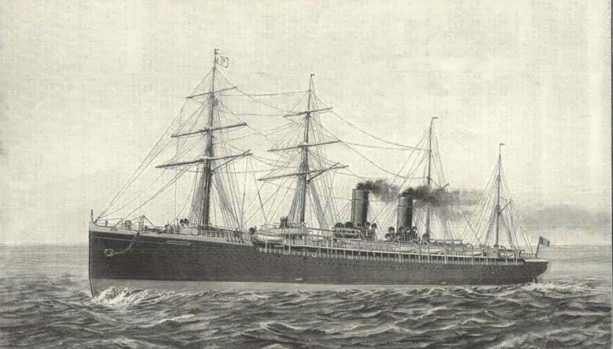
La Bourgogne was cursed. On July 4, 1898 in dense fog the Brutish ship Cromartyshire, traveling at full speed, rammed La Bourgogne.
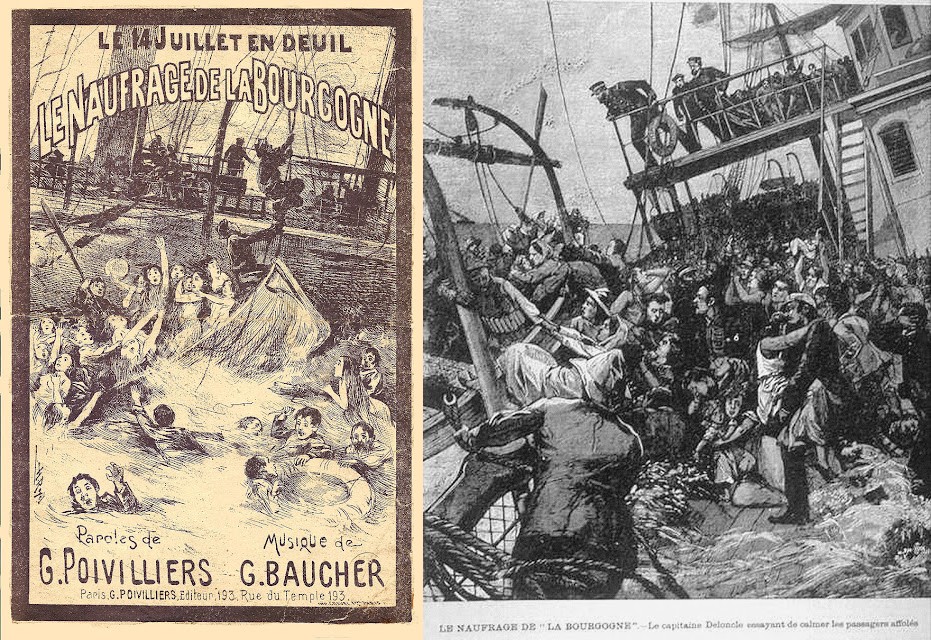
“La Bourgogne began to list immediately to starboard. Many of the lifeboats on that side were wrecked in the collision and the boats on the port side proved impossible to launch due to the list. As the ship started to list and the stern went under, the crew began to panic. Showing little concern for the passengers, the crew began piling up on whatever lifeboats were available and launched them to sea. Some used fists and oars to beat up any passengers who attempted to come near the boats. Some passengers were stabbed. Half an hour later La Bourgogne completely disappeared beneath the waves, taking with her almost every woman and every single child.”
Of teh 220 crew, half survived. Of the 506 passengers, only about 70 survived. All the children died.
Americans demanded that the crew be tried and punished. The French whitewashed everything, and nothing was done. Instead they put out this propganda poster.
Robert William Lawrence, Founder of Tasmanian Botany
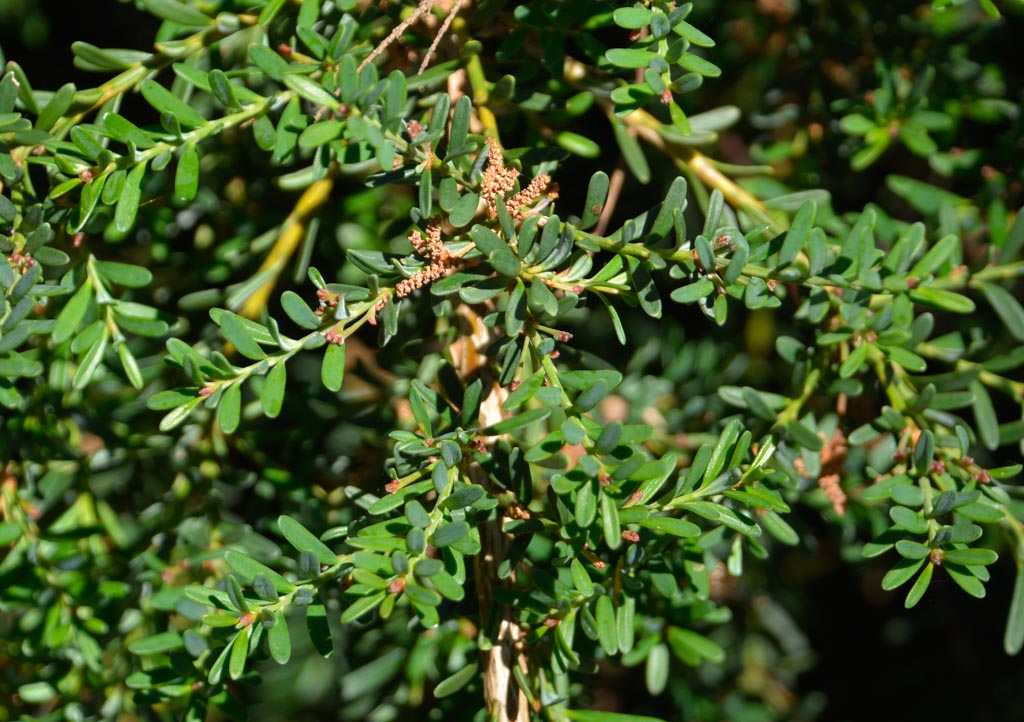
Podocarpus lawrencei
Robert William Lawrence (1807–1833), first-born son of William Effingham Lawrence, was born and educated in England. In 1825 he arrived in Van Diemen’s Land (Tasmania) (per the Elizabeth). He became acquainted with Sir William Jackson Hooker, the Regius Professor of Botany at the University of Glasgow and later director of the Botanical Gardens at Kew in London, from whose friendship he developed a passion as an amateur botanist, sending many specimens from the Colony to Kew, resulting in Hooker’s “Flora Tasmaniae” in 1860. Lawrence was Tasmania’s first botanist, and introduced Ronald Campbell Gunn to Hooker. The native fuchsia mountain correa was named by Hooker Correa lawrenciana in honour of his young protégé.
Lawrence lived in a house “Vermont” which was built for him by his father near Launceston, later moving to his father’s estate “Formosa” as overseer. In 1832 he married Anne Wedge (1808-1833) but she died the following year giving birth to their daughter Annie Emily Lawrence. Lawrence died weeks later. Gunn wrote to Hooker: “It is with feelings of the deepest regret I have to communicate to you the death of our mutual friend Mr W. R. Lawrence. This melancholy event took place at Formosa on the night of 18 October last, the day on which he attained his 26th year, and the first anniversary day of his marriage. Twelve months ago poor Lawrence married a young and most amiable Lady, with whom he lived in the most happy state it is possible for mortals to enjoy in this world, and on 2 September last I left them, after a short visit both in the enjoyment of excellent health; next day Mrs Lawrence was safely delivered of a daughter, but from delicacy of constitution, or too sudden an exposure after her confinement, she was in a few days seized with a fever which terminated fatally within a month, – fatally to Lawrence’s happiness and peace”.
Lawrence died of an apoplectic fit a few weeks later, the coronial jury delivered a verdict of ‘died by a visitation of God’. The infant daughter, Annie Emily Lawrence, was raised by her maternal grandparents in Van Diemens Land and later Port Phillip, where she married Monckton Synnot.
References
Born in England on 18 October 1807, died at ‘Formosa’, Tasmania, on 18 October 1833, possibly due to an epileptic fit.
The first son of a wealthy English merchant, William Effingham Lawrence (1781-1841). The father with his wife and two of Robert’s siblings migrated to Van Diemen’s Land in 1822-23. He purchased a cutter, the Lord Liverpool, to make the journey. William became an influential landowner near Launceston on granted land.
Robert had stayed in England and followed his family to Tasmania in April 1825. His father built a house, Vermont, for him near the North Esk River where he resided until around June 1832 when he moved to the family estate of Formosa near Cressy to act as overseer of his father’s estate.
Recruited by W.Hooker in 1830 as a collector’ he forwarded specimens to Kew until 1832. He made the first collections, including the type of Podocarpos lawrencii, from the mountains south west of Launceston, the Western Tiers, which rise close behind his family property ‘Formosa’. He was instrumental in recruiting Gunn as a collector for Kew. After his untimely death in 1833 his collections were included in Gunn’s herbarium; these bear the initials RWL and usually a Lawrence number. His main collection is in K, with some duplicates in G, MANCH, NSW and OXF.
A much longer biography is in Dick Burns’ book, Pathfinders in Tasmanian Botany, published by the Tasmanian Arboretum in 2012.
In one of his early letters to Hooker in 1830 he wrote:
“. . . I have a taste for the science of Botany.
– My knowledge of this science is certainly very slight indeed,
I am a mere learner and without a preceptor but I hope that in time,
by application I shall become as much of a Botanist as to enable me
to be useful to you now if you will accept my services such as they may be.”
Plants named in his honour include:
Correa lawrenciana (1834)
The genus Lawrencella (1839) with two arid Australian paper-daisy species
The genus Lawrencia (1840) with 16 Australian species in the Malvaceae
Podocarpos lawrencei (1845)
Spyridium lawrencei (1863)
Deyeuxia lawrencei (1940) a grass now presumed extinct.
William Effingham Lawrence
husband of 3rd great-grandaunt of wife
William Effingham Lawrence (1781–1841) was an English colonist to Australia, the son of Captain Effingham Lawrence, a merchant with houses in London, Liverpool and New York City. Previous generations of Lawrences had settled in the American colonies but returned to England after the War of Independence. Lawrence was an educated and refined man, an intimate of Jeremy Bentham, who was obliged to migrate to the colony of Van Diemen’s Land due to poor health. On his leaving England Bentham wrote to a friend in Rio de Janeiro: ‘Our excellent friend on his way to Australia is not without thoughts of touching at Rio de Janeiro: a worthier man, a more benevolent cosmopolite, never left any country; and very few better informed or more intelligent’.
He purchased a small cutter, the Lord Liverpool and sailed via South America in 1822. On the way he sailed into Rio de Janeiro for provisions and water. Brazil, a Portuguese colony since the 16th century, was in the midst of a struggle for independence, and Lawrence became personally involved through his friendship with José Bonifácio, the liberal revolutionary and first minister under the new government of Dom Pedro, who had defied his father in Lisbon and declared Brazil independent in 1822. Lawrence was captivated by events and remained for months in the country, becoming a confidant of José Bonifácio, the architect of Brazilian independence. Bonifácio wanted Lawrence to remain in the country permanently, but Lawrence declined, and after several exciting months, sailed on for Van Diemen’s Land.
Lawrence arrived in 1823 and, by order of the Colonial Office was ordered a grant of 4,000 acres (16 km²) with his brother, with a reserve after 5 years of a further 4,000 acres (16 km²). These 8,000 acres (32 km²) of land became the subject of controversy, because the grant was to be exclusive of waste land. In the end, due to the mismanagement of the surveyor general, the grant ended up being some 12,000 acres (49 km²). The colony was small and gossip, jealousy and petty rivalry was rife. When Colonel George Arthur arrived he was informed of the size of the grant, and ordered an inquiry, sending John Helder Wedge to survey the grant.
Wedge and Lawrence became friends and Wedge’s niece Anne Wedge married Lawrence’s son Robert William Lawrence in 1832.
Lawrence’s pastoral interests continued throughout the next 20 years and he eventually became one of the largest landowners in the colony. Lawrence was also prominent in the field of education, helping establish a school in the Norfolk Plains, which was not a success. He then formed a committee with Henty and Mulgrave for the formation of a Church of England school in Launceston, but died before the foundation of Launceston Church of England Grammar School.
Under Governor Sir John Franklin Lawrence was appointed to the Legislative Council and retained his seat until his death in 1841. Of his sons Robert William Lawrence died young in 1833, and the others remained in the colonies, except for Edward Effingham Lawrence, who returned to England to be educated and became a Cornet in the 7th Dragoon Guards in 1856 and taking part in the Austro-Sardinian War (1860–61).
James Henry Caldwell

James Henry Caldwell (1865-1931) was the son of Edward Holland Caldwell (1844-1872) and Caroline Amelia Shields (1846-1934) and the grandson of the thespian James Henry Caldwell (1793-1863). As James Henry’s mother remarried after his father died, he had half-siblings with the name of Rubira. James Henry was the great granduncle of my wife.
James Henry was born in Mobile, Alabama, and attended private schools in Maryland and New York before entering Rensselaer Polytechnic Institute, from which he graduated with a B.S. om 1886. There he was Delta Phi. He returned to work as a civil engineer for the family business, the Mobile Gas Works, and installed electricity in that city, fifty four years after his grandfather had installed gas.. In 1888 James Henry associated with the Ludlow Valve Manufacturing. In 1892 he became vice president, in 1893 general manager, and in 1909 president. He organized teh Troy Trust Company and became its first president, and became directors of numerous banks and companies. He was an Episcopalian and warden of St. Paul’s church.
James H. Caldwell married, in Troy, May 3. 1887, Margery Josephine Christie, daughter of John T. Christie, of Troy, and granddaughter of John and Margaret (Roberts) Christie, who came to the United States from Scotland in 1832, and settled first in Troy, later moving to New Jersey. Mr. and Mrs. Caldwell are the parents of three children: 1. Margery, married, June 16, 1916, Livingstone W. Houston, of Troy, and has two children: Margery C. and Nancy. 2. John Christie, born June 10, 1893, educated in St. Mark’s School, of Southboro, Massachusetts, and the Rensselaer Polytechnic Institute, now associated with the Ludlow Valve Manufacturing Company; married Helen Greatsinger Farrell. 3. Carolyn, educated in the Emma Willard School of Troy, Miss Masters’ School of Dobbs Ferry, New York, and Miss Wickham’s School of New York City; she married, May 28, 1921, Cebra Quackenbush Graves, of Bennington, Vermont, and New York City.
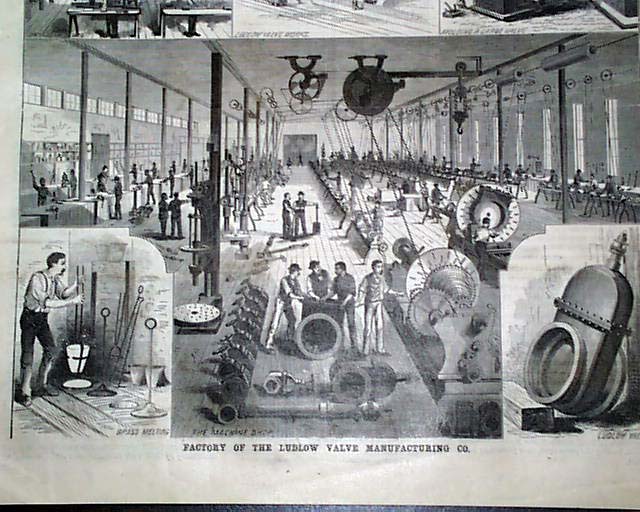
The Ludlow Valve Manufacturing Company was founded by Henry Ludlow in 1861. Ludlow, a native of Nassau, NY, had graduated with an engineering degree from Union College in 1843. He started the company in Waterford, NY but it quickly grew and Ludlow moved it first to Lansingburgh, NY, in 1872, and then to Troy, NY in 1897. When the company moved to Troy it took over the facilities of the Rensselaer Iron Company (Rensselaer Iron and Steel Company) located on the Poestenkill River in South Troy. Ludlow Valve Manufacturing Company was locally managed by four presidents until the 1930s. The first president was Henry Ludlow and he remained in the position until the early 1890s when he was succeeded by John Christie. At this time, Ludlow sold his interests in the company to a group of investors from New York City. The company was one of the largest valve manufacturers in the country and had continued success under Christie and his nephew James H. Caldwell. James H. Caldwell graduated from Rensselaer Polytechnic Institute in 1886 and joined the Ludlow Valve Manufacturing Company in 1888. In 1892 he was elected vice president, in 1893 he became general manager and in 1909 he took over the role of president for the company. During his presidency, Ludlow Valve Manufacturing Company was the largest valve and fire hydrant manufacturer in the country and perhaps the largest in the world. Interestingly enough, Caldwell was also Vice President of Rensselaer Polytechnic Institute and his daughter was married to Livingston W. Houston, future president of both the Ludlow Valve Manufacturing Company and Rensselaer Polytechnic Institute. Caldwell retired as president from Ludlow in the late 1920’s and evidence exists that a man named William H. Lolley succeeded him. Lolley was president of Ludlow during crucial years in the early 1930’s when serious investigation was taking place regarding the current and future of the company. When Lolley left (mid 1930’s), Livingston Houston took over as president of Ludlow. Houston, using Lolly’s recommendations, introduced a series of changes designed to make Ludlow as prominent as it had once been. Houston did not remain president for long, leaving the company in 1935 for a position at RPI. However, he did remain involved in the company as a board member for many more years. Despite efforts by the Board of Directors, a series of ineffective presidents plagued the business for many years. A merger with Rensselaer Valve Company was one more effort to revive Ludlow Valve Manufacturing Company in 1954. It was hoped that Ludlow could reduce employees, gain strong management and consolidate assets through this merger. However, physical dismantling of Rensselaer Valve Company was lengthy and expensive. In the early 1960s, all the problems faced by Ludlow-Rensselaer Valve Company came to a head. Foreclosure proceedings were brought against the company by James Talcott and Company, a primary lender. Future attempts at reorganization were for naught, and in 1969 final dismantling was initiated. Ludlow valves are still manufactured today under the Patterson Pump Company name in Georgia.
Edward Holland Caldwell
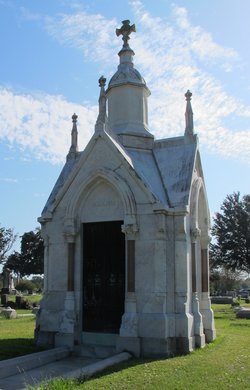
Edward Holland Caldwell (1844-1872) was the son of James Henry Caldwell and Margaret Placide (Margaret Abrams). The parents were not married. James Henry was still married to Maria Carter Hall, who remained in Virginia. Edward Holland was the second great-grandfather of my wife.
On March 11, 1857 an act was passed by the Louisiana legislature allowing Edward Holland and his brother James Henry Jr. (1838-1870) to inherit on the same basis as legitimate children.
Edward Holland, was born in New Orleans, Louisiana, January 8, 1844, died in New York City, October 5, 1872. He was associated with his father in the gas and banking companies. He was president of the Mobile Gas Light and Coke Company, and made his residence in Mobile. The family were Catholics, except Edward Holland Caldwell, who embraced the Protestant faith. This allowed him to become a thirty-second degree of the Scottish Rite of the Masons.
Edward Holland married Caroline Amelia Shields, a native of Mobile. She survived her husband, and married Santos Santiago Rubira (1832-1914), a prominent capitalist of Mobile.
The children of Edward Holland and Caroline Amelia were:
James Henry (1865-1931)
Edward Shields (1867-1925) a capitalist of Asheville, North Carolina, and an extensive traveler; he married Louise Wood Moore.
Sarah (1871-1947), married (first) Nathaniel Rutter (1863-1891), of New York City, leaving a son, Edward Caldwell Rutter (1890-1947): she married (second) 1902, Nathaniel Claude Reynal (1871-1928), of New York City. Their children were Nathalie (1902-1968), Nathaniel Jules (1903-1950), and Amilie (1909-1917).
Jonathan Lawrence pere
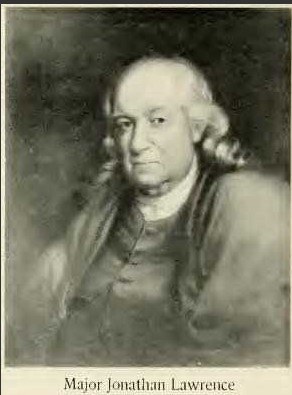
Jonathan Lawrence (1737 – 1812) was an American merchant and politician from New York. He was the paternal grandfather of the wife of 3rd great-granduncle of my wife.
Jonathan was born on October 4, 1737 in Newtown, Queens County, in what was then the Province of New York. He was the eighth son born to Patience (née Sackett) Lawrence (1701–1772) and John Lawrence (1695–1765).
His paternal grandparents were John Lawrence and Deborah (née Woodhull) Lawrence and his maternal grandparents were Capt. Joseph Sackett and Elizabeth (née Betts) Sackett. His paternal great grandparents were Thomas Lawrence (1619 – 1703) and Mary Ferguson (1624-1692) who emigrated to North America.
Jonathan’s brother Daniel Lawrence was an Assemblyman and his nephew Nathaniel Lawrence (son of Thomas) was New York State Attorney General. Congressman James Lent and Recorder Richard Riker were his great-nephews.
At a young age, Jonathan became a merchant, visiting Europe and the West Indies in the employment of his eldest brother, John Lawrence, before joining the house of Watson, Murray & Lawrence. After inheriting his brother John’s estate and a portion of his brother Nathaniel’s estate (who died unmarried in the West Indies), he retired c. 1771, around age thirty-four, and purchased a residence at Hurlgate which had been owned by his great-grandfather Thomas Lawrence, the youngest of three brothers who emigrated to America around 1645.
In 1772, he had been appointed captain in the provincial militia by the royal government. Once the New York Provincial Congress organized a militia in 1775, he was appointed major of the Queens and Suffolk brigade under Gen. Nathaniel Woodhull.
In August 1776, on the eve of the Battle of Long Island, his militia was sent to drive livestock in an effort to prevent it from falling into British hands. While the activities indirectly claimed the life of Woodhull, he had been ordered to Harlem to seek reinforcements from General George Washington.
Beginning in May 1775 Lawrence was a member of the 1st, 3rd (May to June 1776) and 4th New York Provincial Congresses (beginning in July 1776, which became known as the First Constitutional Convention)
Lawrence was appointed by Constitutional Convention to represent the Southern District of New York (consisting of Kings, New York, Queens, Richmond, Suffolk and Westchester counties) in the New York State Senate beginning with the 1st New York State Legislature in 1777 to the 6th in 1783. On October 17, 1778, he was one of four elected to the Council of Appointment, serving for one year. He was again one of four elected to the Council on July 22, 1782.
He later served as chairman of the city’s committee for the reelection of George Clinton as governor (who later became the 4th Vice President of the United States under Thomas Jefferson and James Madison).
On March 16, 1766, he married Judith Fish (1749–1767), the daughter of Nathaniel Fish and Jannetje (née Berrien) Fish (a sister of Judge John Berrien). Jannetje’s niece, Elizabeth Berrien, was married to Fish’s nephew Nathaniel Lawrence, and was the aunt of John M. Berrien, the United States Attorney General under President Andrew Jackson. Before Judith’s death on September 29, 1767, at age seventeen, they were the parents of one son: Jonathan Lawrence (1767–1850) (q.v.), a merchant with Lawrence & Whitney who married Elizabeth Rogers.
After his first wife’s death in 1767, the elder Jonathan married Ruth Riker (1746–1818), a member of the Riker family, for whom Rikers Island is named. Ruth was the daughter of Andrew and Jane Riker. Together, they were the parents of nine children, including:
Judith Lawrence (1769–1827), who married John Ireland (1749–1836).
Margaret Lawrence (1771–1851), who died unmarried, aged 81.
Samuel Lawrence (1773–1837), who married Elizabeth Ireland,[1] and became a U.S. Representative.
Andrew Lawrence (1775–1806), a sailor who died “of the African fever, in one of the Dutch factory islands, near an outlet of that river, which has since been discovered to be the ancient Niger.”
Richard M. Lawrence (1778–1856), a merchant who sailed around the world, and upon his return to New York in 1815, became the vice-president of the National Insurance Company and then president of the Union Insurance Company, both in New York.
Abraham Riker Lawrence (1780–1863), who served as president of the New York and Harlem Railroad in 1836 (after John Mason).
Joseph Lawrence (1783–1817), who married Mary Sackett, daughter of John Sackett and Elizabeth (née Gibbs) Sackett.
John L. Lawrence (1785–1849), who married Sarah Augusta Smith (1794–1877), daughter of General John Tangier Smith and granddaughter of Gen. Nathaniel Woodhull.
William Thomas Lawrence (1788–1859), a merchant who married Margaret Sophia Muller, daughter of Remburtus F. Muller, in 1825.
Lawrence died on September 4, 1812 in New York City.
Through his eldest daughter Judith, he was a grandfather of John Lawrence Ireland (1796–1879), who married Mary Floyd, a sister of John Gelston Floyd, a U.S. Representative, and a granddaughter of David Gelston (the Collector of the Port of New York) and William Floyd (a signer of the United States Declaration of Independence). Ireland was the father of John Busteed Ireland (who married Adelia Duane Pell, daughter of Robert Livingston Pell). Another grandchild was Louisa Anna Ireland (1800–1845), who married Henry Woodhull Nicholl, and was the mother of three: Elizabeth Smith Nicholl (first wife of Gen. Alexander Hamilton, a grandson, and namesake, of Gen. Alexander Hamilton, the first Secretary of the Treasury), Mary Louisa Ireland (wife of Maj. Henry Constantine Wayne of the U.S. Army), and Judith Ireland (wife of Capt. William Blair).
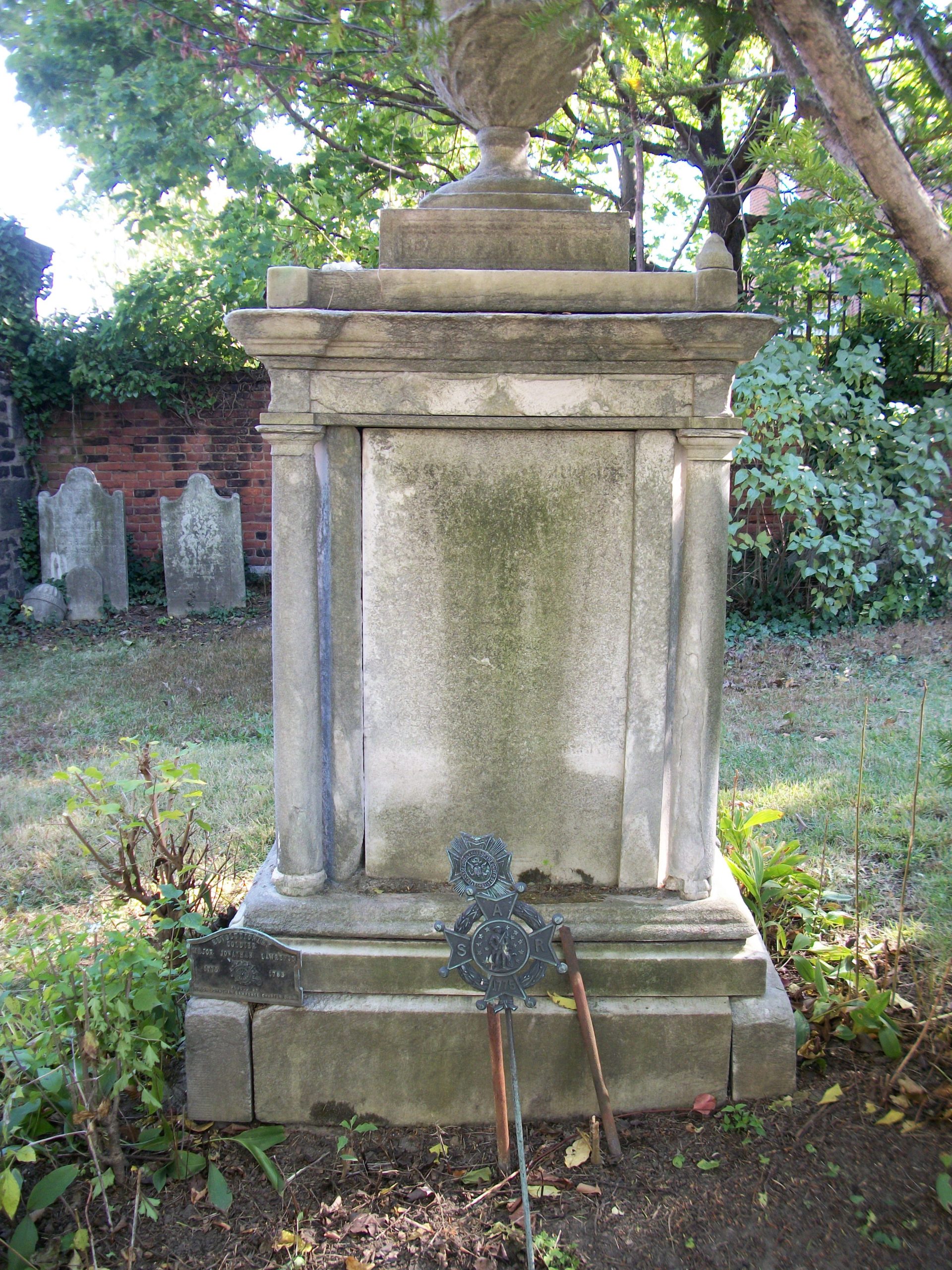
Jonathan Lawrence, son of John & Patience Lawrence, born in Newtown Oct. 4, 1737 O. S., died in the City of New York Sept. 1, 1812. His long and exemplary life was distinguished by private & public usefulness. He was a member of the Provincial Congress of 1776 and of the convention that established the Constitution of this State, and represented the Southern District in Senate until the Peace of 1783.
Under this Monument lies the remains of Jonathan Lawrence and Ruth Lawrence, his wife. They were united by the sincerest affection for more than forty years and now sleep together in one sepulchre.
Alfred Newbold Lawrence
John L. Lawrence
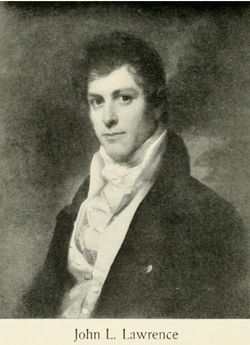
John L. Lawrence 1785-1849
Distinguished career in Politics and Public Service: Appointed Secretary of Legation to Sweden, became United States Charge at Stockholm, elected member of Assembly for NYC, elected State Senator, first president of the Croton Aqueduct Commisson, Treasurer of Columbia College and Controller of the City of New York.
Husband of Sarah Augusta Smith. They were parents of eleven children, including: Mary [died young], Richard, Egbert, Robert, Charles Jeffrey, Ann Middleton Suydam and Hon Abraham Riker Lawrence. Died of cholera.
John L. Lawrence (October 2, 1785 – July 24, 1849) was an American lawyer, diplomat, and politician from New York.
Early life
John was born in New York City. He was the son of Jonathan Lawrence (1737–1812), a merchant and New York State Senator, and Ruth (née Riker) Lawrence (1746–1818), a member of the Riker family, for whom Rikers Island is named.[1] Among his siblings were brothers Samuel Lawrence (1773–1837), a Congressmen, and William T. Lawrence (1788–1859).[2]
He was also a direct descendant of Capt. James Lawrence, a hero of the War of 1812,[3] and Maj. Thomas Lawrence of the British Army who received a land grant in 1656 in what became Queens.[4]
He graduated from Columbia College in 1803.[5]
Career
From June 7, 1814, to May 19, 1815, he was Chargé d’Affaires at Stockholm, representing the United States during the absence of Minister to Sweden Jonathan Russell.[6]
He was a member of the New York State Assembly (New York Co.) in 1816–17. He was a delegate to the New York State Constitutional Convention of 1821.[7]
He was a presidential elector in 1840, voting for William Henry Harrison and John Tyler.[7]
He was a member of the New York State Senate (4th D.) in 1848 and 1849. In May 1849, he was appointed New York City Comptroller,[8] but died two months later.[7]
Personal life
On June 2, 1816, he married Sarah Augusta Smith (1794–1877), daughter of Elizabeth (née Woodhull) Smith (daughter of Gen. Nathaniel Woodhull) and General John Tangier Smith, a U.S. Representative and U.S. Senator from New York.[9] Together, John and Sarah were the parents of eleven children, including Abraham Riker Lawrence, a Justice of the Supreme Court of New York.[10]
Lawrence died of cholera in New York City on July 24, 1849.[11]
Abraham Riker Lawrence
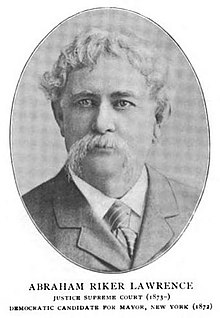
Abraham Riker Lawrence (September 19, 1832 – February 14, 1917)[1] was an American lawyer, judge, and historian.
Early life[edit]
Abraham was born in New York City on September 19, 1832 and was the namesake of his paternal uncle, Abraham Riker Lawrence, a merchant.[2][3] He was one of eleven children born to John L. Lawrence (1785–1849) and Sarah Augusta (née Smith) Lawrence (1794–1877). Among his siblings was Ann Middleton (née Lawrence) Suydam, who married John Richard Suydam, a merchant and “gentleman well-known in New-York society for his genial and hospitably qualities” (parents of Jane Mesier Suydam),[4] Richard Montgomery Lawrence; and Charles William Lawrence.[5] His father was a New York State Senator, Comptroller of New York City and diplomat (who served as chargé d’Affaires at Stockholm during the absence of U.S. Minister to Sweden Jonathan Russell).[1]
His paternal grandparents were Jonathan Lawrence, a merchant and New York State Senator, and Ruth (née Riker) Lawrence, a member of the Riker family, for whom Rikers Island is named.[6] Among his extended family were uncles, Congressmen Samuel Lawrence and William T. Lawrence, as well as William Beach Lawrence, the Lieutenant Governor of Rhode Island, and Brigadier General Albert G. Lawrence.[2] He was also a direct descendant of Capt. James Lawrence, a hero of the War of 1812,[7] and Maj. Thomas Lawrence of the British Army who received a land grant in what became Queens in 1656.[8] His maternal grandparents were Elizabeth (née Woodhull) Smith (daughter of Gen. Nathaniel Woodhull) and General John Tangier Smith, a U.S. Representative and U.S. Senator from New York.[9]
Lawrence was educated at private schools and then attended and graduated from Ballston Spa Law School in Ballston Spa, New York.[9]
Career[edit]
After being admitted to the bar in 1853, he was appointed and served as Assistant Corporation Counsel of New York City from 1853 to 1856 and from 1857 to 1858. In 1859, Lawrence wrote Compilation of the Tax Laws of the State of New York, with notes of Cases.[10] In 1867, he was a member of the Constitutional Convention. In 1870, he was one of the founders of the Association of the Bar of the City of New York (serving as vice-president in 1905 and 1906).[9]
Political career[edit]
In 1870, he was a leading member of Apollo Hall,[11] a Democratic reform movement founded by New York State Senator James O’Brien as a response to the corruption of Boss Tweed controlled Tammany Hall.[12]
In 1872, Lawrence, then a lawyer doing business at 25 Nassau Street, was selected by both Tammany Hall (even though he had been a vocal opponent of Tammany)[13] and the Greeleyites as the Democratic candidate for mayor of New York City against the O’Brien, the Apollo candidate, and William Frederick Havemeyer, the Republican candidate.[11][14] Lawrence came in second place, losing to Havemeyer,[15] in what became Havemeyer’s third non-consecutive term as mayor.[1]
In 1873, he was elected a justice of the Supreme Court of New York. He was reelected in 1887 and served on the bench for twenty-eight years until December 31, 1901.[16] After his retirement, a dinner was given in his honor at Delmonico’s and hosted by John Edward Parsons, president of the Bar Association.[16] From 1911 until his death, he served as the official Referee of the Supreme Court.[1]
Society life[edit]
Lawrence was a member of the Union Club, the Century Club and the Manhattan Club. In addition to membership in the Society of Colonial Wars (serving as Chancellor in 1895)[5] and the American Rifle Association, he served two terms as president the 25th President of the Saint Nicholas Society of the City of New York from 1882 to 1883, succeeding Edward Floyd DeLancey.[9] He previously served as fourth vice-president in 1878, second vice-president in 1879, and first vice-president from 1880 to 1881.[17]
Personal life[edit]
In 1860, Lawrence was married to Elizabeth “Eliza” Williams Miner (1838–1915).[18] Eliza was the only daughter of Dr. William Miner and Julia Caroline (née Williams) Miner. Together, Eliza and Abraham were the parents of:[5]
William Miner Lawrence (1861–1935),[8] a member of the New York State Assembly in 1891 who married Lavinia Oliver (1869–1916).[5]
Ruth Woodhull Lawrence (1866–1956),[7] who did not marry and who was a founder of the National Society of Colonial Dames in New York in 1893.[19][7]
Lawrence died at his home, 69 Washington Place in New York City, on February 14, 1917.[1] He was buried at the Lawrence Family Cemetery, on 20th Road and 35th Street, in Astoria, Queens.[20]
Descendants[edit]
Through his son William, he was the grandfather of Oliver P. Lawrence (1892–1975), a U.S. Navy veteran, Clement Lawrence, who died young, and Ruth Lawrence (1902–1992), who married Stuart M. Briggs (son of G. Loring Briggs), in 1926.[21] Ruth, who graduated from Wellesley College in 1925, was one of only five non-family members to inherit from Hetty Green, through her mentorship relationship with Green’s son, Edward Howland Robinson Green.[22]
Charles Hedges McKinstry
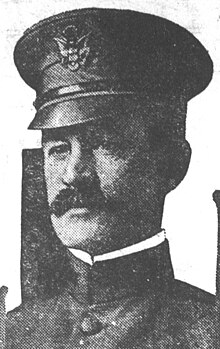
Charles Hedges McKinstry (1866-1961) was an engineer and army officer for the United States Military. He was a descendant of William Bradford (1589-1657) , governor of the Plymouth Bay Colony.
McKinstry was born on December 19, 1866, in San Francisco, California. He attended the United States Military Academy and graduated in 1888, number two of forty-four in his class.
Military career
McKinstry was an instructor of engineering in West Point for the Corps of Engineers at the Engineering School of Application from 1891 to 1893.[2] On June 11, 1888, McKinstry made second lieutenant and on July 22, 1888, he was promoted to first lieutenant.[2] On October 11, 1892, McKinstry became a captain.[2] Then on July 5, 1898, he became a major.[2] After becoming a major, McKinstry went on to be in charge of defensive works and harbors improvements in Key West from 1898 to 1900.[2] From 1901 to 1903, he was at the Engineer School in Willets Point, New York, as an instructor, which included instruction in astronomy.[1] McKinstry moved on to Southern California during 1903–1906 to work on fortifications, rivers and harbors.[2] On January 1, 1906, he became a lieutenant colonel.[2] In 1909, McKinstry became chief engineer in the Philippine Island Division until 1911.[2] On February 27, 1912, he was promoted to brigadier general and then became commander of the 158th Field Artillery Brigade on August 5, 1917.[2] In 1919, McKinstry retired as a colonel.[1]
Personal life
He married
On January 10, 1920, Lillie Lawrence McKinstry, his wife, died in Miami, Florida. In 1924 he married Evelyn McCurdy Salisbury Wells, with whom he had three children. McKinstry regained his rank of brigadier general in June 1930. On November 29, 1961, McKinstry died in Santa Barbara, California, at the age of 94 and just a few weeks before his 95th birthday.[1]
Baron von Zedtwitz
WRECKED 81 THE
Baron von Zedtwitz Killed
in a Collision at Royal
Albert Races.
Meteor Crashed Into His Vessel
and He Was K.locked
Overboard.
Struck on the Head by a Flying
Piece of Wood, Never Re
gained Consciousness.
CREW THROWN INTO THE WATER.
Strong Wind Was Blowing at the Time of
the Accident, and a Heavy Sea
Was Running?Postponed
Festivities.
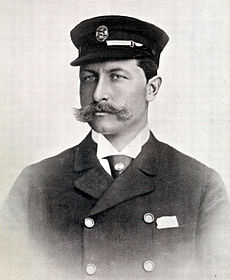
London. Aug. 18.?The races of the Royal
Albert Regatta at Sontlisea were Inter
rupted to-day by an accident which caused
the death of Beron von Zetwitz, the
owner of the twenty-rater Isolde, and
endangered the lives of the captain and
jrew of that vessel, all of whom were
knocked overboard.
The large raters started at 10 o’clock
this morning to go over the forty-six-mile
course sailed over yesterday, and the small
raters started at 11 o’clock to sail over
the same course, but only once round?
twenty-three miles. The starters in the
big race were the Ailsa, Britannia, Meteor
and Satanita, and those in the small rater
races were The Saint, Niagara, Samp
shire, Audrey, Ptenitent and Isolde.
The big yachts had finished the first
round of the course and were just starting
upon the second round when suddenly the
boats of both classes seemed to have be
come jammed together. The Isolde, which
was sandwiched between two yachts of the
larger class, received a severe blow from
the Kaiser’s yachj: Meteor, causing her
mast to snap in two and fall overboard.
Tlirown Into tlie Sen.
The shock was a heavy one, causing the
Isolde to careen, and, as she did so, all ou
board of her were spilled Into the sea.
When Meteor struck the small yacht
there ns great crash, and blocks,, frag
ments of the broken mast and other parts
of the Isolde were sent flying In every di
rection.
As soon as the collision took place the
other yachts stopped and put out boats to
rescue the men struggling in the water.
on von Zedtwitz, the owner of the
Iso’iuv, who was on board of his yacht,
was 8 -nek on the head by a. block, or u
piece of broken mast, and knocked over
board. lie w \taken out of the water as
soon as possible and conveyed on board a
steam yacht to the clubhouse at Hyde.
Bnron von Zedtwitz was unconscious when
picked up. lie received every possible
medical attention at Ryde, but he did not
regain consciousness and died soon after
reaching the clubhouse.
A strong wind was blowing at the time
of the accident, kicking up a bad sea, and
it was raining hard. The Isolde was badly
damaged and was twoed to Portsmouth.
The bowsprit of the Meteor swept her
deck and carried away all of her gear.
Several members of the Isolde’s crew were
?picked up in an exhausted condition.
Narrow E?caj?cs of tl?<? Men.
The crew had some very narrow escapes,
but, fortunately, ail of them were rescued.
A sailor belonging to the British gunboat
Ant, which was lying at anchor near the
scene of the collision, rescued one of the
Isolde’s rnpa, who could not have survived
thirty seconds longer. The accident cast a
gloom over -everything, and the races were
abandoned for the day.
Captain Gome*, the skipper of the Meteor,
ascribes the collision of his vessel with the
Isolde to the fact (hat the Britannia did not
make way for the Meteor to pass the Isolde.
All of the clubhouses at Spithead and
I.tyde are flying flags at half mast in con
sequence of the death of the Baron. As a
yachtsman he was a ?ood sportsman and ho
was well liked in all of the English sport
ing centres. Ills wife, the Baroness von
7!odtwltz, w.is daughter of the late
Charles Roosevelt, of New York.
Festivities Postponed.
To-morrow’s yacht races and the fire
works, with which It was Intended to sig
nalize the ending of the Royil Albert Yacht
Club regatta at So’.thsea, have been post
poned until after the funeral.
Toe Isolds wan a twwtr-rater yacht.
constructed by the Hcrreshoffs at Bristol,
it. I., In 1895, for Prince Leopold of Ger
many, who afterward sold the boat to
Baron von Zedtwits.
The Meteor, which is owned by the Ger
man Emperor, is a steel cutter of 236 tons,
and was built at the Hendersons* yards, on
on the Clyde, In the early part of this year
Waldemar von Zedtwitz
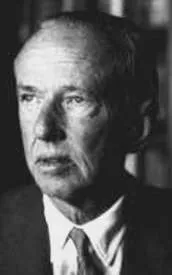
Von Zedtwitz was born in Berlin, Germany. His mother was Mary Elizabeth Breckinridge Caldwell,[3] daughter of American businessman William Shakespeare Caldwell, one of Louisville’s first millionaires by the late 1850s,[4][5] and sister of Mary Gwendoline, Marquise des Monstiers-Mérinville.[6] His father was Baron Moritz Curt von Zedtwitz, a German diplomat who belonged to the old Zedtwitz noble family, which rose under the Electorate of Saxony. His parents were married in June 1890.[6] His father died in a boating accident on August 18, 1896,[7][4] when he was just three months old.
He was educated at Berlin and Bern, and later served in the German cavalry during World War I. He became a naturalized American citizen.[2]
He was a lexicographer and linguist.[1]
Von Zedtwitz was a keen backgammon player, winning a major tournament at age 82. He lived for 47 years in New York City before relocating to Hawaii in 1977. He died in Hawaii in 1984.[2]
He was friends with Harold Vanderbilt, the inventor of contract bridge, and became an early and enthusiastic competitor and promoter of the game, including a tour of Europe.[2]
Von Zedtwitz was 1932 president of the American Bridge League, one of the organizations whose merger established the American Contract Bridge League (ACBL) in 1937. The ACBL credits him with saving it by his emergency service as president in 1948 and 1949.[8] He was a founder of the World Bridge Federation.[2]
There is an endowed Waldemar von Zedtwitz Chair at Yale university/